
Why Every Accounting Roll-Up Should Be a Fintech
The accounting roll-up market is never been hotter.
170 PE-backed deals closed in 2025. Every direct PE investment now spawns roughly 7.6 follow-on acquisitions on average, per IFAC. Citrin Cooperman flipped from New Mountain to Blackstone at a reported $2 billion.
Ascend, Doeren Mayhew, Aprio, Sorren, and Crete are racing to consolidate the mid-market. Almost half the top 30 CPA firms in the country now have PE inside the cap table. And almost all of them are running the same playbook. Buy fragmented firms. Centralize back office. Standardize tech. Layer in AI to automate compliance work. Expand margins. Sell at a higher multiple in five years.
It's a fine playbook. It's just not the one with the biggest lever.
The biggest lever sitting inside every accounting roll-up isn't cost synergies. It's the client base.
The asset everyone is leaving on the table
Here's what makes accounting roll-ups structurally different from every other roll-up out there.
When PE rolls up HVAC, the platform sells services to homeowners. Same for dental, vet, fitness, landscaping. The end customer is a consumer. There's no obvious second product to sell them.
Accounting is different. Accounting roll-ups sell to SMBs. And SMBs need a stack of services that have nothing to do with tax prep or bookkeeping. They need payroll. They need benefits for their employees. They need a business bank account. They need to accept and send payments.
Today, those services are being bought somewhere else. ADP, Paychex, Gusto, regional banks, separate brokers, Square, Stripe. Money flowing out of the SMB to vendors who, frankly, have a worse relationship with that SMB than the SMB's accountant does.
The accountant is the trusted advisor. The accountant already sees the client's payroll runs, tax filings, bank statements, and headcount. The accountant is the one the SMB calls before they hire, before they expand, before they file. That trust position is the most valuable distribution channel in financial services for SMBs, and it's sitting unused inside every accounting platform that isn't embedding fintech.
The math
Take a regional accounting platform with just 1,000 SMB clients across its roll-up. That's not a Top 100 firm. That's a CPA platform two or three bolt-ons into its journey.
If 25% of those clients adopt embedded payroll at $50 per month base plus $10 per employee per month, and the average client has 10 employees, that's $450,000 in net new annual recurring revenue. From clients the firm already has, with zero new logos acquired.
And payroll is just the wedge. Once you're running an SMB's payroll, you have the data, the trust, and the natural reason to have the next conversation. Business banking. Corporate cards. Embedded payments for clients with merchant volume. Treasury and cash management for the ones sitting on idle balances. Each one is a recurring revenue line. Each one stacks on top of the payroll relationship instead of replacing it.
Now look at the multiplier. Every bolt-on the platform closes brings another batch of SMB clients into the same revenue model. A platform that's done 10 bolt-ons isn't capturing this revenue once. It's capturing it ten times over, and the growth shows up every quarter without the firm selling a single new logo.
The point isn't the exact number. It's that this isn't margin expansion. It's a net new recurring revenue line that compounds with the firm's existing fee base. A platform doing this across 10,000 or 100,000 SMB clients isn't a CPA firm with a side hustle. It's a fintech.
Payroll is also a churn fighter
The new revenue line is half the story. The other half is what payroll does to retention, and retention is what drives enterprise value at exit.
Payroll is the stickiest product in the SMB stack. Switching means re-onboarding employees, re-registering state tax accounts, reconciling mid-year W-2s, and explaining to staff why their direct deposit looks different this pay period. SMBs don't switch payroll for fun. They switch under duress, and most put it off for years even then.
When the accounting firm owns the payroll relationship, that stickiness transfers to the firm. An SMB shopping a competing tax engagement letter isn't just shopping accounting fees anymore. They're staring down a full back-office migration. Most of them don't go through with it. Firms that embed payroll into their CAS practice consistently see materially lower client churn than firms that don't.
Lower churn compounds enterprise value.
PE-backed accounting platforms are increasingly getting valued on software-business metrics: net revenue retention, gross retention, ARPU growth. The funds underwriting the next wave of deals want what public-market investors want in vertical SaaS. Citrin Cooperman's ~$2B flip from New Mountain to Blackstone showed that the high end of the accounting market is now playing by those rules.
The math at exit is unforgiving. A multiple turn or two on a $40M EBITDA platform is $40M to $80M in enterprise value at the same operating performance. Embedded payroll is one of the cheapest ways to move that needle, because every payrolled client is a client your competitors have to work twice as hard to take from you.
The AI defense nobody is talking about
There's a quieter reason this matters more right now than it did three years ago.
The compliance work that has historically driven accounting firm revenue (tax prep, bookkeeping, basic write-up work) is the part of the value chain AI is most aggressively eating. Every PE deck talks about AI as a margin expansion tool, which it is. It's also a margin compression tool, because clients eventually figure out the work is getting cheaper to produce, and pricing follows cost.
Embedded fintech revenue doesn't move with that curve. Payroll fees are recurring. Benefits commissions are recurring. Banking spread is recurring. None of it is exposed to "the LLM did my taxes for $20" pricing pressure, because none of it is compliance work. It's infrastructure the SMB will keep using whether or not their bookkeeping line item collapses.
If you're underwriting an accounting roll-up at a 10-12x EBITDA multiple, the real question isn't whether AI compresses your tax prep revenue over the next five years. It's whether you have a revenue line that doesn't compress.
What good looks like
For the platforms and operators reading this, four things to actually do.
Treat embedded fintech as a core revenue product, not a partnership referral.
The 10% commission deal with a third-party payroll vendor is not the same business as owning the payroll relationship. One captures a kickback. The other captures a recurring revenue stream, the data, and the client.
Pick infrastructure that lets you white-label.
Your SMB clients should see your firm's brand on every paystub, every benefits enrollment, every business banking interaction. The trust premium is yours, not the vendor's. Don't give it away.
Build the offer into the bolt-on integration playbook.
Every newly acquired firm comes with a client base that needs to be onboarded to the platform's product stack. If you're already standardizing tax software and practice management at acquisition, embedded fintech belongs on that same checklist. Day 1, not year 2.
Get your CAS team in the room.
Client Accounting and Advisory Services is where the embedded fintech story lands hardest. CAS clients are already paying for outsourced finance ops. Adding payroll, benefits, and banking to that bundle isn't a cross-sell. It's the natural next layer of the offering.
The infrastructure for all of this used to mean stitching together five vendors.
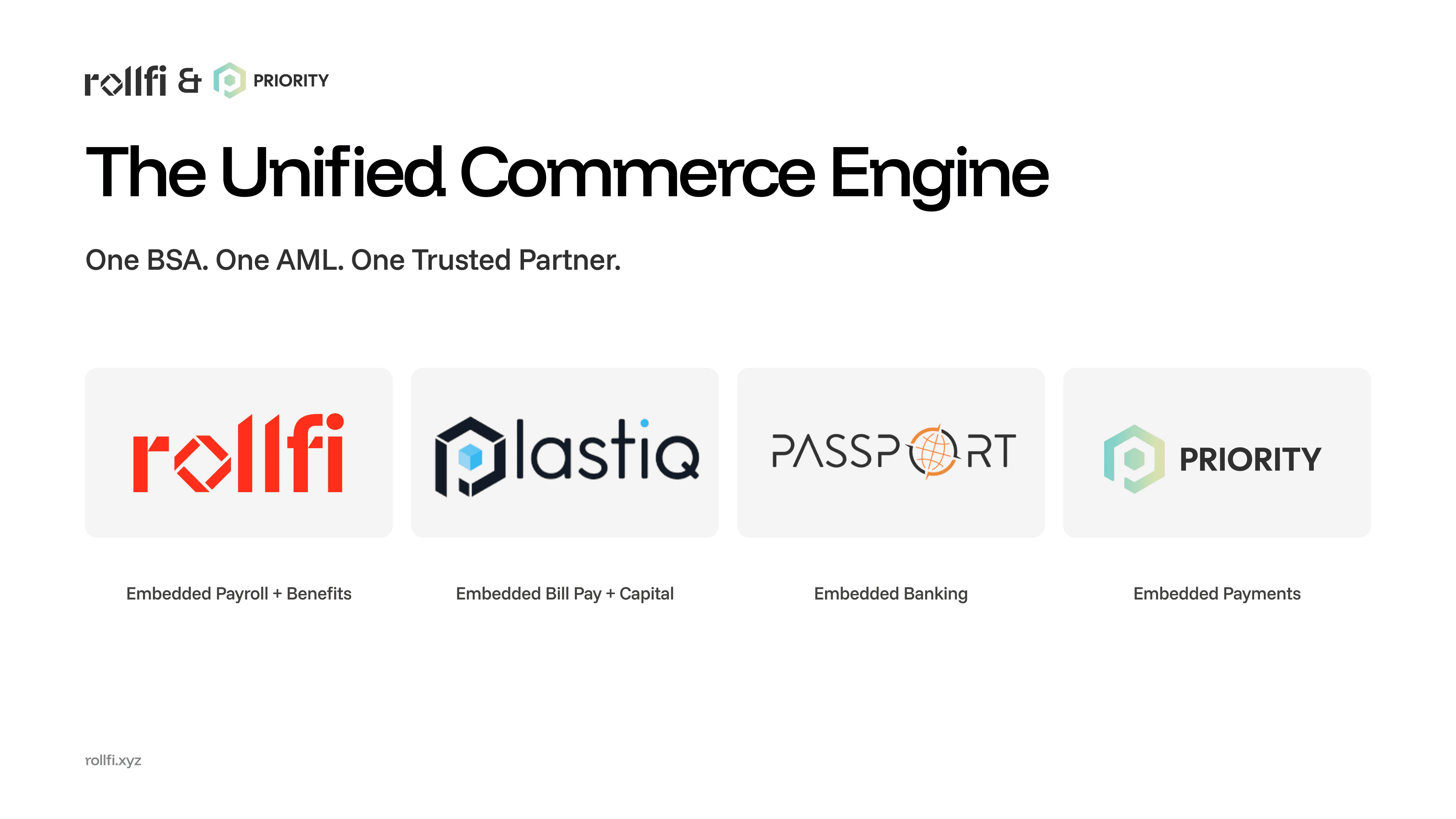
Priority's acquisition of Rollfi brought payroll & benefits under the same Commerce Engine that already powered banking, payments, and treasury, so a platform can turn the entire stack on through one relationship instead of running parallel integration projects.
The platforms that win the next cycle
The accounting industry is mid-consolidation. The early movers have set their platforms. The middle innings are about who builds the most defensible revenue model on top of what they bought.
Platforms that treat themselves as services businesses will compete on margin, fee compression, and AI cost takeout. That's a real game. It's also a brutal one.
Platforms that treat themselves as fintechs sitting on top of an SMB client base will compete on ARPU, attach rate, and net revenue retention. That's a different game with much better unit economics. The public market already knows how to value it.
If you're running an accounting roll-up in 2026, the question to ask isn't "how do we automate more of what we already do." It's "what else can we sell to the clients we already have, and who owns that infrastructure."
About Rollfi
Rollfi empowers banks, vertical SaaS platforms, accounting firms, and fintechs to add payroll and benefits to their offerings through white-label solutions and robust APIs. With Rollfi's infrastructure, platforms can unlock new revenue, boost customer retention, and gain valuable payroll data insights. Fast deployment and full regulatory coverage make Rollfi the easiest way to turn your platform into a one-stop shop for essential business services.
The accounting roll-up market is never been hotter.
170 PE-backed deals closed in 2025. Every direct PE investment now spawns roughly 7.6 follow-on acquisitions on average, per IFAC. Citrin Cooperman flipped from New Mountain to Blackstone at a reported $2 billion.
Ascend, Doeren Mayhew, Aprio, Sorren, and Crete are racing to consolidate the mid-market. Almost half the top 30 CPA firms in the country now have PE inside the cap table. And almost all of them are running the same playbook. Buy fragmented firms. Centralize back office. Standardize tech. Layer in AI to automate compliance work. Expand margins. Sell at a higher multiple in five years.
It's a fine playbook. It's just not the one with the biggest lever.
The biggest lever sitting inside every accounting roll-up isn't cost synergies. It's the client base.
The asset everyone is leaving on the table
Here's what makes accounting roll-ups structurally different from every other roll-up out there.
When PE rolls up HVAC, the platform sells services to homeowners. Same for dental, vet, fitness, landscaping. The end customer is a consumer. There's no obvious second product to sell them.
Accounting is different. Accounting roll-ups sell to SMBs. And SMBs need a stack of services that have nothing to do with tax prep or bookkeeping. They need payroll. They need benefits for their employees. They need a business bank account. They need to accept and send payments.
Today, those services are being bought somewhere else. ADP, Paychex, Gusto, regional banks, separate brokers, Square, Stripe. Money flowing out of the SMB to vendors who, frankly, have a worse relationship with that SMB than the SMB's accountant does.
The accountant is the trusted advisor. The accountant already sees the client's payroll runs, tax filings, bank statements, and headcount. The accountant is the one the SMB calls before they hire, before they expand, before they file. That trust position is the most valuable distribution channel in financial services for SMBs, and it's sitting unused inside every accounting platform that isn't embedding fintech.
The math
Take a regional accounting platform with just 1,000 SMB clients across its roll-up. That's not a Top 100 firm. That's a CPA platform two or three bolt-ons into its journey.
If 25% of those clients adopt embedded payroll at $50 per month base plus $10 per employee per month, and the average client has 10 employees, that's $450,000 in net new annual recurring revenue. From clients the firm already has, with zero new logos acquired.
And payroll is just the wedge. Once you're running an SMB's payroll, you have the data, the trust, and the natural reason to have the next conversation. Business banking. Corporate cards. Embedded payments for clients with merchant volume. Treasury and cash management for the ones sitting on idle balances. Each one is a recurring revenue line. Each one stacks on top of the payroll relationship instead of replacing it.
Now look at the multiplier. Every bolt-on the platform closes brings another batch of SMB clients into the same revenue model. A platform that's done 10 bolt-ons isn't capturing this revenue once. It's capturing it ten times over, and the growth shows up every quarter without the firm selling a single new logo.
The point isn't the exact number. It's that this isn't margin expansion. It's a net new recurring revenue line that compounds with the firm's existing fee base. A platform doing this across 10,000 or 100,000 SMB clients isn't a CPA firm with a side hustle. It's a fintech.
Payroll is also a churn fighter
The new revenue line is half the story. The other half is what payroll does to retention, and retention is what drives enterprise value at exit.
Payroll is the stickiest product in the SMB stack. Switching means re-onboarding employees, re-registering state tax accounts, reconciling mid-year W-2s, and explaining to staff why their direct deposit looks different this pay period. SMBs don't switch payroll for fun. They switch under duress, and most put it off for years even then.
When the accounting firm owns the payroll relationship, that stickiness transfers to the firm. An SMB shopping a competing tax engagement letter isn't just shopping accounting fees anymore. They're staring down a full back-office migration. Most of them don't go through with it. Firms that embed payroll into their CAS practice consistently see materially lower client churn than firms that don't.
Lower churn compounds enterprise value.
PE-backed accounting platforms are increasingly getting valued on software-business metrics: net revenue retention, gross retention, ARPU growth. The funds underwriting the next wave of deals want what public-market investors want in vertical SaaS. Citrin Cooperman's ~$2B flip from New Mountain to Blackstone showed that the high end of the accounting market is now playing by those rules.
The math at exit is unforgiving. A multiple turn or two on a $40M EBITDA platform is $40M to $80M in enterprise value at the same operating performance. Embedded payroll is one of the cheapest ways to move that needle, because every payrolled client is a client your competitors have to work twice as hard to take from you.
The AI defense nobody is talking about
There's a quieter reason this matters more right now than it did three years ago.
The compliance work that has historically driven accounting firm revenue (tax prep, bookkeeping, basic write-up work) is the part of the value chain AI is most aggressively eating. Every PE deck talks about AI as a margin expansion tool, which it is. It's also a margin compression tool, because clients eventually figure out the work is getting cheaper to produce, and pricing follows cost.
Embedded fintech revenue doesn't move with that curve. Payroll fees are recurring. Benefits commissions are recurring. Banking spread is recurring. None of it is exposed to "the LLM did my taxes for $20" pricing pressure, because none of it is compliance work. It's infrastructure the SMB will keep using whether or not their bookkeeping line item collapses.
If you're underwriting an accounting roll-up at a 10-12x EBITDA multiple, the real question isn't whether AI compresses your tax prep revenue over the next five years. It's whether you have a revenue line that doesn't compress.
What good looks like
For the platforms and operators reading this, four things to actually do.
Treat embedded fintech as a core revenue product, not a partnership referral.
The 10% commission deal with a third-party payroll vendor is not the same business as owning the payroll relationship. One captures a kickback. The other captures a recurring revenue stream, the data, and the client.
Pick infrastructure that lets you white-label.
Your SMB clients should see your firm's brand on every paystub, every benefits enrollment, every business banking interaction. The trust premium is yours, not the vendor's. Don't give it away.
Build the offer into the bolt-on integration playbook.
Every newly acquired firm comes with a client base that needs to be onboarded to the platform's product stack. If you're already standardizing tax software and practice management at acquisition, embedded fintech belongs on that same checklist. Day 1, not year 2.
Get your CAS team in the room.
Client Accounting and Advisory Services is where the embedded fintech story lands hardest. CAS clients are already paying for outsourced finance ops. Adding payroll, benefits, and banking to that bundle isn't a cross-sell. It's the natural next layer of the offering.
The infrastructure for all of this used to mean stitching together five vendors.
Priority's acquisition of Rollfi brought payroll & benefits under the same Commerce Engine that already powered banking, payments, and treasury, so a platform can turn the entire stack on through one relationship instead of running parallel integration projects.
The platforms that win the next cycle
The accounting industry is mid-consolidation. The early movers have set their platforms. The middle innings are about who builds the most defensible revenue model on top of what they bought.
Platforms that treat themselves as services businesses will compete on margin, fee compression, and AI cost takeout. That's a real game. It's also a brutal one.
Platforms that treat themselves as fintechs sitting on top of an SMB client base will compete on ARPU, attach rate, and net revenue retention. That's a different game with much better unit economics. The public market already knows how to value it.
If you're running an accounting roll-up in 2026, the question to ask isn't "how do we automate more of what we already do." It's "what else can we sell to the clients we already have, and who owns that infrastructure."
About Rollfi
Rollfi empowers banks, vertical SaaS platforms, accounting firms, and fintechs to add payroll and benefits to their offerings through white-label solutions and robust APIs. With Rollfi's infrastructure, platforms can unlock new revenue, boost customer retention, and gain valuable payroll data insights. Fast deployment and full regulatory coverage make Rollfi the easiest way to turn your platform into a one-stop shop for essential business services.
The accounting roll-up market is never been hotter.
170 PE-backed deals closed in 2025. Every direct PE investment now spawns roughly 7.6 follow-on acquisitions on average, per IFAC. Citrin Cooperman flipped from New Mountain to Blackstone at a reported $2 billion.
Ascend, Doeren Mayhew, Aprio, Sorren, and Crete are racing to consolidate the mid-market. Almost half the top 30 CPA firms in the country now have PE inside the cap table. And almost all of them are running the same playbook. Buy fragmented firms. Centralize back office. Standardize tech. Layer in AI to automate compliance work. Expand margins. Sell at a higher multiple in five years.
It's a fine playbook. It's just not the one with the biggest lever.
The biggest lever sitting inside every accounting roll-up isn't cost synergies. It's the client base.
The asset everyone is leaving on the table
Here's what makes accounting roll-ups structurally different from every other roll-up out there.
When PE rolls up HVAC, the platform sells services to homeowners. Same for dental, vet, fitness, landscaping. The end customer is a consumer. There's no obvious second product to sell them.
Accounting is different. Accounting roll-ups sell to SMBs. And SMBs need a stack of services that have nothing to do with tax prep or bookkeeping. They need payroll. They need benefits for their employees. They need a business bank account. They need to accept and send payments.
Today, those services are being bought somewhere else. ADP, Paychex, Gusto, regional banks, separate brokers, Square, Stripe. Money flowing out of the SMB to vendors who, frankly, have a worse relationship with that SMB than the SMB's accountant does.
The accountant is the trusted advisor. The accountant already sees the client's payroll runs, tax filings, bank statements, and headcount. The accountant is the one the SMB calls before they hire, before they expand, before they file. That trust position is the most valuable distribution channel in financial services for SMBs, and it's sitting unused inside every accounting platform that isn't embedding fintech.
The math
Take a regional accounting platform with just 1,000 SMB clients across its roll-up. That's not a Top 100 firm. That's a CPA platform two or three bolt-ons into its journey.
If 25% of those clients adopt embedded payroll at $50 per month base plus $10 per employee per month, and the average client has 10 employees, that's $450,000 in net new annual recurring revenue. From clients the firm already has, with zero new logos acquired.
And payroll is just the wedge. Once you're running an SMB's payroll, you have the data, the trust, and the natural reason to have the next conversation. Business banking. Corporate cards. Embedded payments for clients with merchant volume. Treasury and cash management for the ones sitting on idle balances. Each one is a recurring revenue line. Each one stacks on top of the payroll relationship instead of replacing it.
Now look at the multiplier. Every bolt-on the platform closes brings another batch of SMB clients into the same revenue model. A platform that's done 10 bolt-ons isn't capturing this revenue once. It's capturing it ten times over, and the growth shows up every quarter without the firm selling a single new logo.
The point isn't the exact number. It's that this isn't margin expansion. It's a net new recurring revenue line that compounds with the firm's existing fee base. A platform doing this across 10,000 or 100,000 SMB clients isn't a CPA firm with a side hustle. It's a fintech.
Payroll is also a churn fighter
The new revenue line is half the story. The other half is what payroll does to retention, and retention is what drives enterprise value at exit.
Payroll is the stickiest product in the SMB stack. Switching means re-onboarding employees, re-registering state tax accounts, reconciling mid-year W-2s, and explaining to staff why their direct deposit looks different this pay period. SMBs don't switch payroll for fun. They switch under duress, and most put it off for years even then.
When the accounting firm owns the payroll relationship, that stickiness transfers to the firm. An SMB shopping a competing tax engagement letter isn't just shopping accounting fees anymore. They're staring down a full back-office migration. Most of them don't go through with it. Firms that embed payroll into their CAS practice consistently see materially lower client churn than firms that don't.
Lower churn compounds enterprise value.
PE-backed accounting platforms are increasingly getting valued on software-business metrics: net revenue retention, gross retention, ARPU growth. The funds underwriting the next wave of deals want what public-market investors want in vertical SaaS. Citrin Cooperman's ~$2B flip from New Mountain to Blackstone showed that the high end of the accounting market is now playing by those rules.
The math at exit is unforgiving. A multiple turn or two on a $40M EBITDA platform is $40M to $80M in enterprise value at the same operating performance. Embedded payroll is one of the cheapest ways to move that needle, because every payrolled client is a client your competitors have to work twice as hard to take from you.
The AI defense nobody is talking about
There's a quieter reason this matters more right now than it did three years ago.
The compliance work that has historically driven accounting firm revenue (tax prep, bookkeeping, basic write-up work) is the part of the value chain AI is most aggressively eating. Every PE deck talks about AI as a margin expansion tool, which it is. It's also a margin compression tool, because clients eventually figure out the work is getting cheaper to produce, and pricing follows cost.
Embedded fintech revenue doesn't move with that curve. Payroll fees are recurring. Benefits commissions are recurring. Banking spread is recurring. None of it is exposed to "the LLM did my taxes for $20" pricing pressure, because none of it is compliance work. It's infrastructure the SMB will keep using whether or not their bookkeeping line item collapses.
If you're underwriting an accounting roll-up at a 10-12x EBITDA multiple, the real question isn't whether AI compresses your tax prep revenue over the next five years. It's whether you have a revenue line that doesn't compress.
What good looks like
For the platforms and operators reading this, four things to actually do.
Treat embedded fintech as a core revenue product, not a partnership referral.
The 10% commission deal with a third-party payroll vendor is not the same business as owning the payroll relationship. One captures a kickback. The other captures a recurring revenue stream, the data, and the client.
Pick infrastructure that lets you white-label.
Your SMB clients should see your firm's brand on every paystub, every benefits enrollment, every business banking interaction. The trust premium is yours, not the vendor's. Don't give it away.
Build the offer into the bolt-on integration playbook.
Every newly acquired firm comes with a client base that needs to be onboarded to the platform's product stack. If you're already standardizing tax software and practice management at acquisition, embedded fintech belongs on that same checklist. Day 1, not year 2.
Get your CAS team in the room.
Client Accounting and Advisory Services is where the embedded fintech story lands hardest. CAS clients are already paying for outsourced finance ops. Adding payroll, benefits, and banking to that bundle isn't a cross-sell. It's the natural next layer of the offering.
The infrastructure for all of this used to mean stitching together five vendors.
Priority's acquisition of Rollfi brought payroll & benefits under the same Commerce Engine that already powered banking, payments, and treasury, so a platform can turn the entire stack on through one relationship instead of running parallel integration projects.
The platforms that win the next cycle
The accounting industry is mid-consolidation. The early movers have set their platforms. The middle innings are about who builds the most defensible revenue model on top of what they bought.
Platforms that treat themselves as services businesses will compete on margin, fee compression, and AI cost takeout. That's a real game. It's also a brutal one.
Platforms that treat themselves as fintechs sitting on top of an SMB client base will compete on ARPU, attach rate, and net revenue retention. That's a different game with much better unit economics. The public market already knows how to value it.
If you're running an accounting roll-up in 2026, the question to ask isn't "how do we automate more of what we already do." It's "what else can we sell to the clients we already have, and who owns that infrastructure."
About Rollfi
Rollfi empowers banks, vertical SaaS platforms, accounting firms, and fintechs to add payroll and benefits to their offerings through white-label solutions and robust APIs. With Rollfi's infrastructure, platforms can unlock new revenue, boost customer retention, and gain valuable payroll data insights. Fast deployment and full regulatory coverage make Rollfi the easiest way to turn your platform into a one-stop shop for essential business services.