
Whitelabel Payroll vs Embedded Payroll
Every partner conversation starts the same way. Do we white label it or do we build on the API?
It's a fair question with a misleading premise. There isn't a switch. There's a dial, and you set it. On one end you can be live with a fully branded payroll product without writing a line of code. On the other end you build every payroll screen yourself. In between is a menu of integrations you pick one at a time.
The useful question isn't which path. It's how much of payroll you want to own, and what that costs you in work. Here's what each one actually involves.
Three positions on the dial
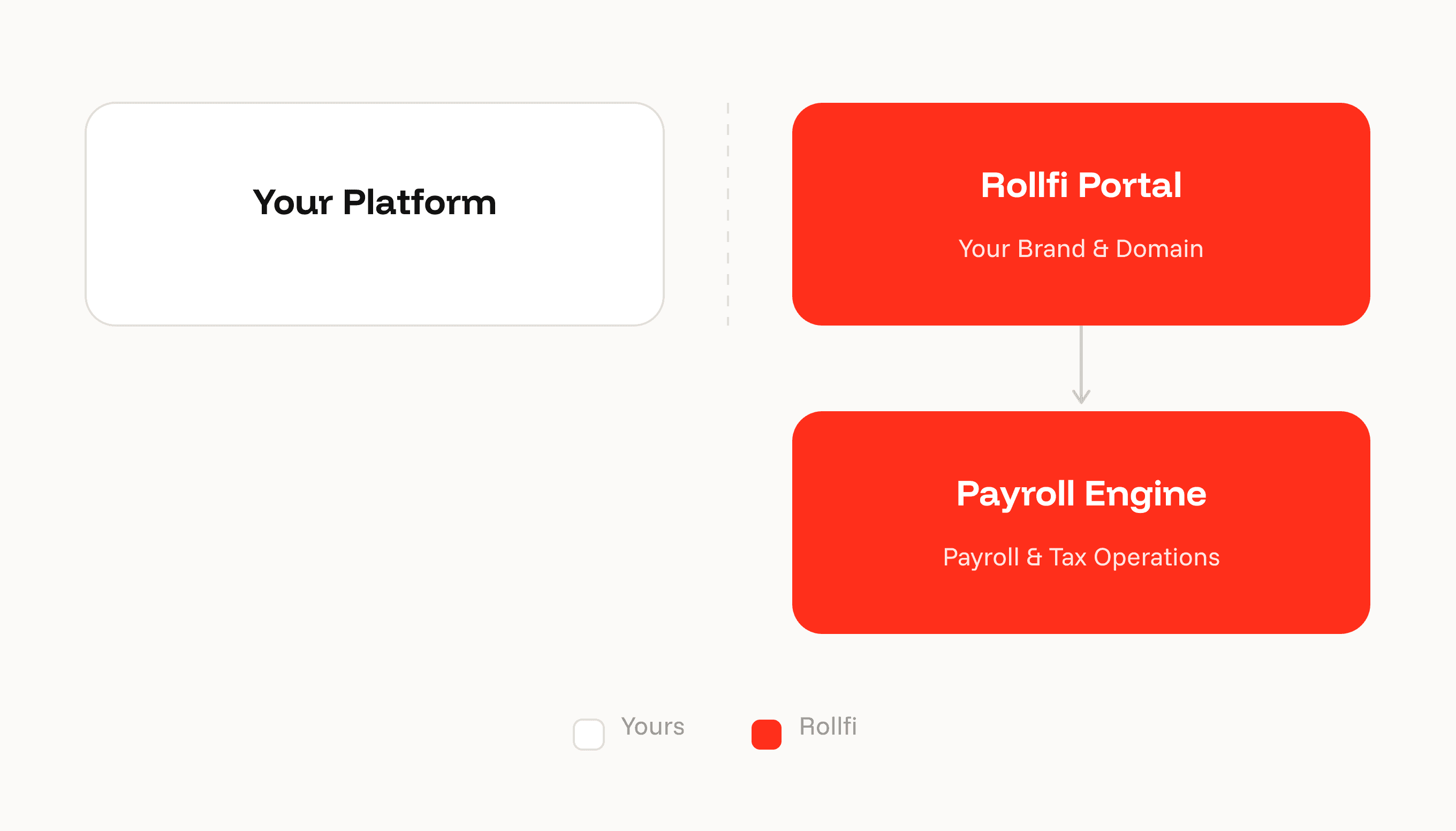
White label. Payroll runs under your brand, on your domain. Zero engineering required.
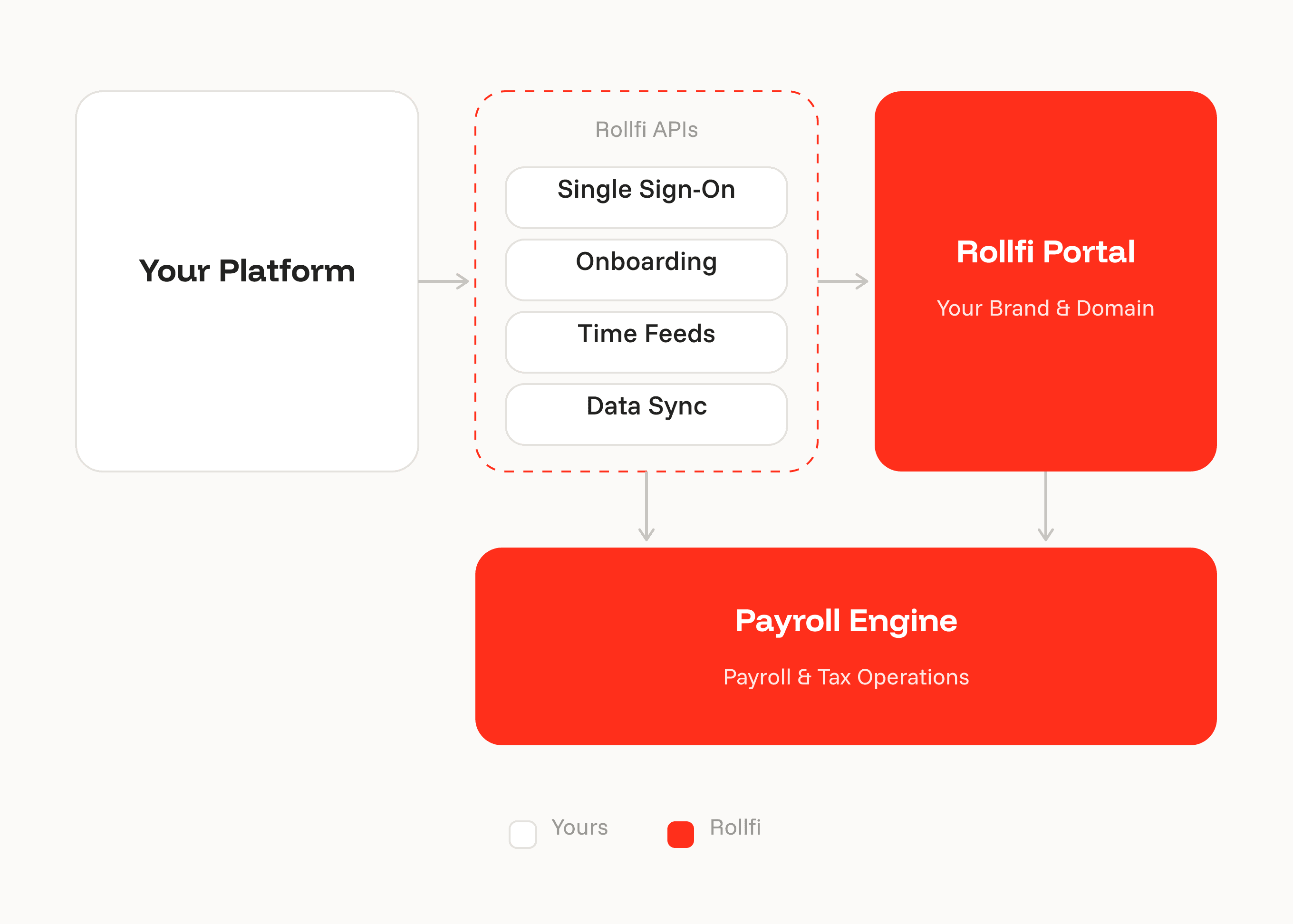
White label plus APIs. The Rollfi Portal stays under your branding, and you connect it to your platform with as many or as few integrations as you want.
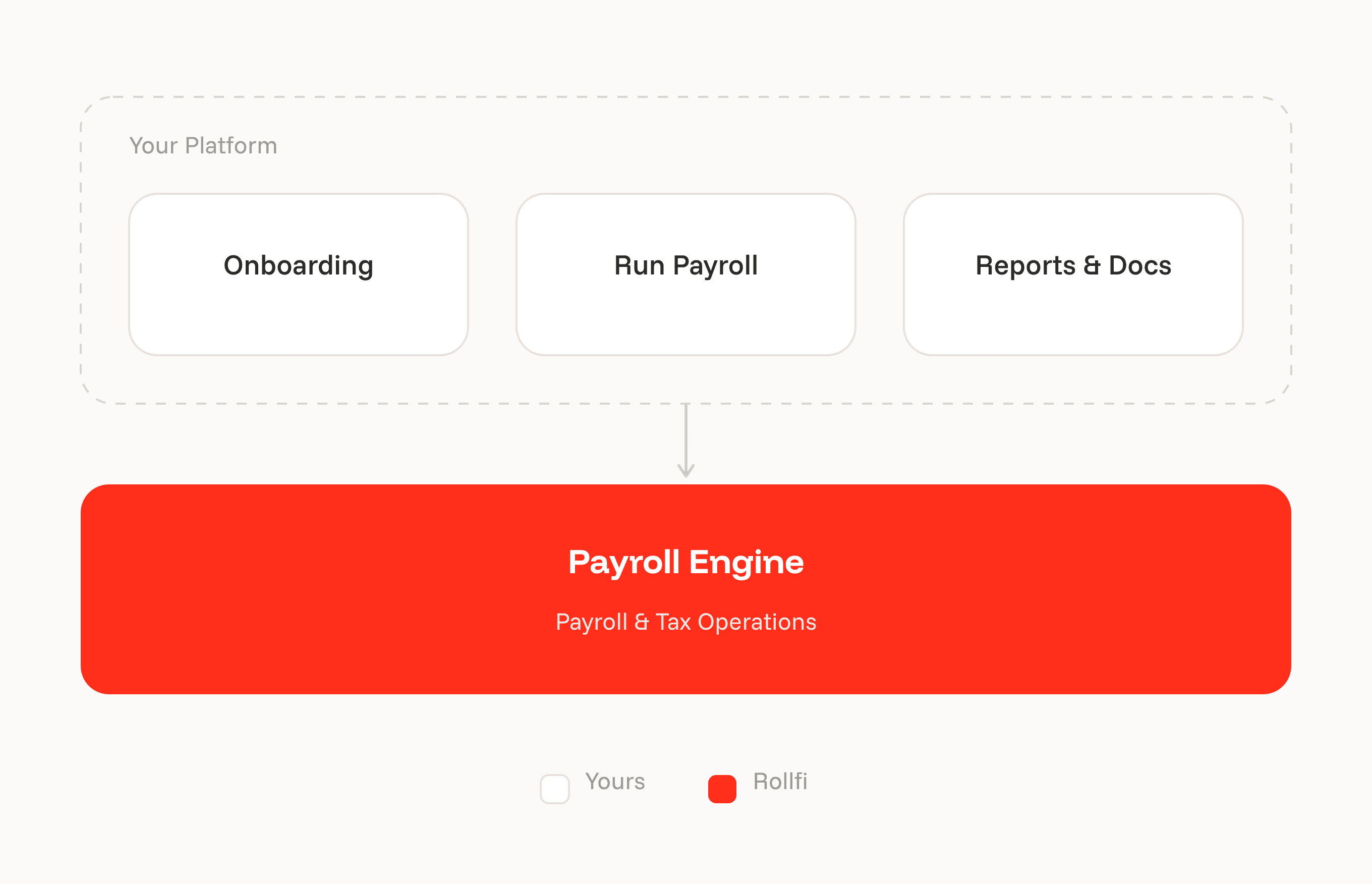
Fully embedded. You build the payroll experience inside your platform and run it on Rollfi's APIs.
All three run on the same APIs underneath, so movement between them is additive rather than a migration.
White label: zero integration is a real option
Worth being clear about this, because plenty of people assume white label is a euphemism for a six-month project.
If you want something standard, you build nothing.
You get the Rollfi Portal, deployed under your own domain and branding. Your logo, your colors, your URL. Employers and employees see your platform, not ours. Behind it sits a partner portal with Partner Admin and Account Manager roles, assigned company access, configurable document permissions, and multi-location support under a single EIN.
The payroll itself is complete out of the box. All fifty states. W-2 employees and 1099 contractors. Automatic tax calculation, filing, and payment. Payroll schedules and off-cycle runs. Reported and cash tips. Reimbursements. Basic time tracking and PTO. Payroll journals and cash requirements reporting. Employees set up direct deposit through Plaid or enter details manually, and get pay stubs, W-2s, and document access.
Benefits come through licensed health and life advisors on a referral link specific to you.
None of that requires an engineer. What it requires is a decision about how you sell it, price it, and support it. Those parts are true on every path, and they're covered below.
White label plus APIs: the menu
The complaint that surfaces once partners are live is rarely branding. It's duplicate data entry.
That's what this tier addresses, and it's opt-in, one piece at a time.
Single sign-on. Your users stop logging in twice.
Onboarding. Company and worker records you already hold get pushed in instead of re-entered, for the business and for the worker. Some fields will never prefill, because they come from the individual rather than from you. Social security numbers, W-4 elections, and bank details are the main ones.
Time feeds. Time data flowing straight into payroll runs, whether you want us holding the punches or you already track time and just need it landing in the right pay period.
Data sync. This is where the detail lives. Multiple rates, overtime, tips, locations, job codes, and differential pay. Usually the integration that takes the most mapping work and returns the most value.
Each one is a discrete project. You can do one, or all four, in any order.
Fully embedded: you're taking on a product
Everything above still applies. Data mapping, support, commercial operations. You're adding to it, not replacing it.
What you're adding is every surface, against the same Payroll APIs described above. Employer onboarding. Employee onboarding. Running payroll. Approvals. Corrections and off-cycle runs. Reports. Tax documents. Employee self-service.
Then the unhappy paths, which are most of payroll. A blocked run. Failed funding. An amended filing. A worker whose classification changed mid-quarter. Each of those is a state your interface has to represent in a way a payroll admin can act on, not a status code rendered in red.
You also own state synchronization. Until it's designed deliberately, your system and ours are two sources of truth about the same employee.
And you own maintenance. Payroll and tax rules change constantly, and those changes reach you as new fields and new requirements. With white label you maintain a connection. Fully embedded, you've adopted a product, and products need owners.
For scale: small teams have built embedded payroll on our APIs with two engineers. What that takes is engineering capacity that's actually committed, not capacity that exists on a roadmap slide.
Five questions that separate the three
Where does duplicate entry actually hurt? Nowhere yet points to white label. Onboarding and timesheets point to two APIs, not a rebuild. Constant and everywhere points to embedded.
Is payroll a place your user goes, or a step inside something they're already doing? If routing someone to a separate portal breaks the workflow, especially on mobile, that pushes toward the API end. If payroll is a destination people visit on a schedule, a branded portal doesn't get in the way.
Do you need your own language, your own mobile experience, your own edge cases? Localization and genuinely custom UX only exist at the fully embedded end. There's no halfway version.
How much do you want to own when payroll breaks? Owning the interface means owning the error states. Someone on your team has to know what a failed funding notice means and what the screen should say.
Is your engineering capacity committed or theoretical? Integrations rarely fail technically. They stall because payroll loses to whatever else is on the roadmap that quarter.
What's true on all three paths
These don't change with integration depth.
You own the customer. Your brand, your relationship, your renewal.
You set the price. You buy at a wholesale rate and price to your market. Billing, invoicing, and collections are yours to run.
You're tier one support. Your customer calls you first. We're tier two, with a shared Slack and email escalation path, partner success support, training materials, and sales and onboarding collateral you can rebrand.
The Payroll Engine stays with us. Tax calculation, filing, and payment run underneath all three paths. We remain visible on tax filings, which is the one place the white label isn't invisible.
Benefits advice sits with licensed advisors, not with your team.
None of these are engineering questions. The integration path determines how much you build. These determine how the business runs.
Moving between paths
The paths aren't permanent, and the work isn't wasted when you change.
Adding APIs to a live white label deployment doesn't disturb the deployment. Your customers keep using the same portal while SSO or onboarding prefill goes in behind it.
Going fully embedded later means building screens against APIs you've already been calling, with real usage data and a real sense of which edge cases your customers hit. The white-label workflows themselves are built on those same APIs, so there's no separate stack to migrate off.
The choice you make first is a choice about where to start, not where to end up.
About Rollfi
Rollfi empowers banks, vertical SaaS platforms, accounting firms, and fintechs to add payroll and benefits to their offerings through white-label solutions and robust APIs. With Rollfi's infrastructure, platforms can unlock new revenue, boost customer retention, and gain valuable payroll data insights. Fast deployment and full regulatory coverage make Rollfi the easiest way to turn your platform into a one-stop shop for essential business services.
Every partner conversation starts the same way. Do we white label it or do we build on the API?
It's a fair question with a misleading premise. There isn't a switch. There's a dial, and you set it. On one end you can be live with a fully branded payroll product without writing a line of code. On the other end you build every payroll screen yourself. In between is a menu of integrations you pick one at a time.
The useful question isn't which path. It's how much of payroll you want to own, and what that costs you in work. Here's what each one actually involves.
Three positions on the dial
White label. Payroll runs under your brand, on your domain. Zero engineering required.
White label plus APIs. The Rollfi Portal stays under your branding, and you connect it to your platform with as many or as few integrations as you want.
Fully embedded. You build the payroll experience inside your platform and run it on Rollfi's APIs.
All three run on the same APIs underneath, so movement between them is additive rather than a migration.
White label: zero integration is a real option
Worth being clear about this, because plenty of people assume white label is a euphemism for a six-month project.
If you want something standard, you build nothing.
You get the Rollfi Portal, deployed under your own domain and branding. Your logo, your colors, your URL. Employers and employees see your platform, not ours. Behind it sits a partner portal with Partner Admin and Account Manager roles, assigned company access, configurable document permissions, and multi-location support under a single EIN.
The payroll itself is complete out of the box. All fifty states. W-2 employees and 1099 contractors. Automatic tax calculation, filing, and payment. Payroll schedules and off-cycle runs. Reported and cash tips. Reimbursements. Basic time tracking and PTO. Payroll journals and cash requirements reporting. Employees set up direct deposit through Plaid or enter details manually, and get pay stubs, W-2s, and document access.
Benefits come through licensed health and life advisors on a referral link specific to you.
None of that requires an engineer. What it requires is a decision about how you sell it, price it, and support it. Those parts are true on every path, and they're covered below.
White label plus APIs: the menu
The complaint that surfaces once partners are live is rarely branding. It's duplicate data entry.
That's what this tier addresses, and it's opt-in, one piece at a time.
Single sign-on. Your users stop logging in twice.
Onboarding. Company and worker records you already hold get pushed in instead of re-entered, for the business and for the worker. Some fields will never prefill, because they come from the individual rather than from you. Social security numbers, W-4 elections, and bank details are the main ones.
Time feeds. Time data flowing straight into payroll runs, whether you want us holding the punches or you already track time and just need it landing in the right pay period.
Data sync. This is where the detail lives. Multiple rates, overtime, tips, locations, job codes, and differential pay. Usually the integration that takes the most mapping work and returns the most value.
Each one is a discrete project. You can do one, or all four, in any order.
Fully embedded: you're taking on a product
Everything above still applies. Data mapping, support, commercial operations. You're adding to it, not replacing it.
What you're adding is every surface, against the same Payroll APIs described above. Employer onboarding. Employee onboarding. Running payroll. Approvals. Corrections and off-cycle runs. Reports. Tax documents. Employee self-service.
Then the unhappy paths, which are most of payroll. A blocked run. Failed funding. An amended filing. A worker whose classification changed mid-quarter. Each of those is a state your interface has to represent in a way a payroll admin can act on, not a status code rendered in red.
You also own state synchronization. Until it's designed deliberately, your system and ours are two sources of truth about the same employee.
And you own maintenance. Payroll and tax rules change constantly, and those changes reach you as new fields and new requirements. With white label you maintain a connection. Fully embedded, you've adopted a product, and products need owners.
For scale: small teams have built embedded payroll on our APIs with two engineers. What that takes is engineering capacity that's actually committed, not capacity that exists on a roadmap slide.
Five questions that separate the three
Where does duplicate entry actually hurt? Nowhere yet points to white label. Onboarding and timesheets point to two APIs, not a rebuild. Constant and everywhere points to embedded.
Is payroll a place your user goes, or a step inside something they're already doing? If routing someone to a separate portal breaks the workflow, especially on mobile, that pushes toward the API end. If payroll is a destination people visit on a schedule, a branded portal doesn't get in the way.
Do you need your own language, your own mobile experience, your own edge cases? Localization and genuinely custom UX only exist at the fully embedded end. There's no halfway version.
How much do you want to own when payroll breaks? Owning the interface means owning the error states. Someone on your team has to know what a failed funding notice means and what the screen should say.
Is your engineering capacity committed or theoretical? Integrations rarely fail technically. They stall because payroll loses to whatever else is on the roadmap that quarter.
What's true on all three paths
These don't change with integration depth.
You own the customer. Your brand, your relationship, your renewal.
You set the price. You buy at a wholesale rate and price to your market. Billing, invoicing, and collections are yours to run.
You're tier one support. Your customer calls you first. We're tier two, with a shared Slack and email escalation path, partner success support, training materials, and sales and onboarding collateral you can rebrand.
The Payroll Engine stays with us. Tax calculation, filing, and payment run underneath all three paths. We remain visible on tax filings, which is the one place the white label isn't invisible.
Benefits advice sits with licensed advisors, not with your team.
None of these are engineering questions. The integration path determines how much you build. These determine how the business runs.
Moving between paths
The paths aren't permanent, and the work isn't wasted when you change.
Adding APIs to a live white label deployment doesn't disturb the deployment. Your customers keep using the same portal while SSO or onboarding prefill goes in behind it.
Going fully embedded later means building screens against APIs you've already been calling, with real usage data and a real sense of which edge cases your customers hit. The white-label workflows themselves are built on those same APIs, so there's no separate stack to migrate off.
The choice you make first is a choice about where to start, not where to end up.
About Rollfi
Rollfi empowers banks, vertical SaaS platforms, accounting firms, and fintechs to add payroll and benefits to their offerings through white-label solutions and robust APIs. With Rollfi's infrastructure, platforms can unlock new revenue, boost customer retention, and gain valuable payroll data insights. Fast deployment and full regulatory coverage make Rollfi the easiest way to turn your platform into a one-stop shop for essential business services.
Every partner conversation starts the same way. Do we white label it or do we build on the API?
It's a fair question with a misleading premise. There isn't a switch. There's a dial, and you set it. On one end you can be live with a fully branded payroll product without writing a line of code. On the other end you build every payroll screen yourself. In between is a menu of integrations you pick one at a time.
The useful question isn't which path. It's how much of payroll you want to own, and what that costs you in work. Here's what each one actually involves.
Three positions on the dial
White label. Payroll runs under your brand, on your domain. Zero engineering required.
White label plus APIs. The Rollfi Portal stays under your branding, and you connect it to your platform with as many or as few integrations as you want.
Fully embedded. You build the payroll experience inside your platform and run it on Rollfi's APIs.
All three run on the same APIs underneath, so movement between them is additive rather than a migration.
White label: zero integration is a real option
Worth being clear about this, because plenty of people assume white label is a euphemism for a six-month project.
If you want something standard, you build nothing.
You get the Rollfi Portal, deployed under your own domain and branding. Your logo, your colors, your URL. Employers and employees see your platform, not ours. Behind it sits a partner portal with Partner Admin and Account Manager roles, assigned company access, configurable document permissions, and multi-location support under a single EIN.
The payroll itself is complete out of the box. All fifty states. W-2 employees and 1099 contractors. Automatic tax calculation, filing, and payment. Payroll schedules and off-cycle runs. Reported and cash tips. Reimbursements. Basic time tracking and PTO. Payroll journals and cash requirements reporting. Employees set up direct deposit through Plaid or enter details manually, and get pay stubs, W-2s, and document access.
Benefits come through licensed health and life advisors on a referral link specific to you.
None of that requires an engineer. What it requires is a decision about how you sell it, price it, and support it. Those parts are true on every path, and they're covered below.
White label plus APIs: the menu
The complaint that surfaces once partners are live is rarely branding. It's duplicate data entry.
That's what this tier addresses, and it's opt-in, one piece at a time.
Single sign-on. Your users stop logging in twice.
Onboarding. Company and worker records you already hold get pushed in instead of re-entered, for the business and for the worker. Some fields will never prefill, because they come from the individual rather than from you. Social security numbers, W-4 elections, and bank details are the main ones.
Time feeds. Time data flowing straight into payroll runs, whether you want us holding the punches or you already track time and just need it landing in the right pay period.
Data sync. This is where the detail lives. Multiple rates, overtime, tips, locations, job codes, and differential pay. Usually the integration that takes the most mapping work and returns the most value.
Each one is a discrete project. You can do one, or all four, in any order.
Fully embedded: you're taking on a product
Everything above still applies. Data mapping, support, commercial operations. You're adding to it, not replacing it.
What you're adding is every surface, against the same Payroll APIs described above. Employer onboarding. Employee onboarding. Running payroll. Approvals. Corrections and off-cycle runs. Reports. Tax documents. Employee self-service.
Then the unhappy paths, which are most of payroll. A blocked run. Failed funding. An amended filing. A worker whose classification changed mid-quarter. Each of those is a state your interface has to represent in a way a payroll admin can act on, not a status code rendered in red.
You also own state synchronization. Until it's designed deliberately, your system and ours are two sources of truth about the same employee.
And you own maintenance. Payroll and tax rules change constantly, and those changes reach you as new fields and new requirements. With white label you maintain a connection. Fully embedded, you've adopted a product, and products need owners.
For scale: small teams have built embedded payroll on our APIs with two engineers. What that takes is engineering capacity that's actually committed, not capacity that exists on a roadmap slide.
Five questions that separate the three
Where does duplicate entry actually hurt? Nowhere yet points to white label. Onboarding and timesheets point to two APIs, not a rebuild. Constant and everywhere points to embedded.
Is payroll a place your user goes, or a step inside something they're already doing? If routing someone to a separate portal breaks the workflow, especially on mobile, that pushes toward the API end. If payroll is a destination people visit on a schedule, a branded portal doesn't get in the way.
Do you need your own language, your own mobile experience, your own edge cases? Localization and genuinely custom UX only exist at the fully embedded end. There's no halfway version.
How much do you want to own when payroll breaks? Owning the interface means owning the error states. Someone on your team has to know what a failed funding notice means and what the screen should say.
Is your engineering capacity committed or theoretical? Integrations rarely fail technically. They stall because payroll loses to whatever else is on the roadmap that quarter.
What's true on all three paths
These don't change with integration depth.
You own the customer. Your brand, your relationship, your renewal.
You set the price. You buy at a wholesale rate and price to your market. Billing, invoicing, and collections are yours to run.
You're tier one support. Your customer calls you first. We're tier two, with a shared Slack and email escalation path, partner success support, training materials, and sales and onboarding collateral you can rebrand.
The Payroll Engine stays with us. Tax calculation, filing, and payment run underneath all three paths. We remain visible on tax filings, which is the one place the white label isn't invisible.
Benefits advice sits with licensed advisors, not with your team.
None of these are engineering questions. The integration path determines how much you build. These determine how the business runs.
Moving between paths
The paths aren't permanent, and the work isn't wasted when you change.
Adding APIs to a live white label deployment doesn't disturb the deployment. Your customers keep using the same portal while SSO or onboarding prefill goes in behind it.
Going fully embedded later means building screens against APIs you've already been calling, with real usage data and a real sense of which edge cases your customers hit. The white-label workflows themselves are built on those same APIs, so there's no separate stack to migrate off.
The choice you make first is a choice about where to start, not where to end up.
About Rollfi
Rollfi empowers banks, vertical SaaS platforms, accounting firms, and fintechs to add payroll and benefits to their offerings through white-label solutions and robust APIs. With Rollfi's infrastructure, platforms can unlock new revenue, boost customer retention, and gain valuable payroll data insights. Fast deployment and full regulatory coverage make Rollfi the easiest way to turn your platform into a one-stop shop for essential business services.