What Embedded Payroll Does to ARPU, CLV, and Payback
Every roadmap meeting turns into the same fight: what do we build next.
Picture a Tuesday planning session at a vertical SaaS company, the kind that runs scheduling and day-to-day operations for auto repair shops, restaurants, staffing agencies, or medical practices. Not a real company, just a composite of conversations we've had with a dozen operators in this exact seat. The scenario is made up. The research and the math behind it are not.
Three things are on the table. An AI assistant feature, because every roadmap has one now. A new integration the sales team has been asking for since Q1. And payroll, sitting at the bottom of the list for two quarters because it sounds like someone else's business, not a software company's.
The AI feature gets the excitement. The integration gets the votes, because three deals are stuck on it. Payroll gets a shrug, until someone drops a link in Slack mid-meeting: Tidemark's chapter on embedded payroll, part of the Vertical SaaS Knowledge Project, the closest thing this category has to a shared playbook. Their take is blunt: this is as big a deal for vertical SaaS as embedded payments was, the highest compliment a vertical SaaS investor pays to a product line, and it's enough to buy payroll five more minutes on the agenda.
The piece is full of numbers that aren't guesses. Standard payroll pricing runs $35 to $70 per customer per month plus $6 to $10 per employee, and it can lift a company's overall ARPU by 40 to 50%. Legacy payroll providers Paycom and Paylocity run annual churn of just 7% and 8%, roughly in line with the 8.5% rate at which small businesses close entirely each year, per the Census data cited in the research, which is its way of saying payroll customers basically don't leave once they're in. Toast's own S-1 noted that by the second quarter of 2021, over half of its newly opened restaurant customers bundled payroll and team management the moment they signed on as a Toast customer. And on the economics: a typical embedded partner takes about a third of the revenue, leaving two thirds for the platform selling it, which starts to look generous next to the alternative of building payroll in-house: tax calculations across 6,000-plus taxes, money movement rules that differ across 42 states, and historically a $50 million, three-plus-year project before anyone could process a single paycheck.
A pricing range, a churn benchmark, an attach proof point, a margin structure. All sourced, none invented. The pattern holds whether the customers are auto shops, restaurants, staffing agencies, coffee shops, or the accounting firms that handle books for all of them. Worth running the company's own numbers through that frame.
So that's what happened next. The hypothetical company has 1,000 customers, 10 employees each on average, paying $100 a month flat, the realistic floor for this kind of operations software, not a hopeful low number. Logo churn runs 10% a year. Payroll gets priced at $40 per company plus $10 per employee, landing inside Tidemark's range on the base fee and at the top of it per employee, a deliberate call given how payroll-heavy this customer base runs.
For a customer with 10 employees, that's $140 a month on top of the existing $100. ARPU goes from $100 to $240. That's the ceiling, what one fully-attached customer is worth.
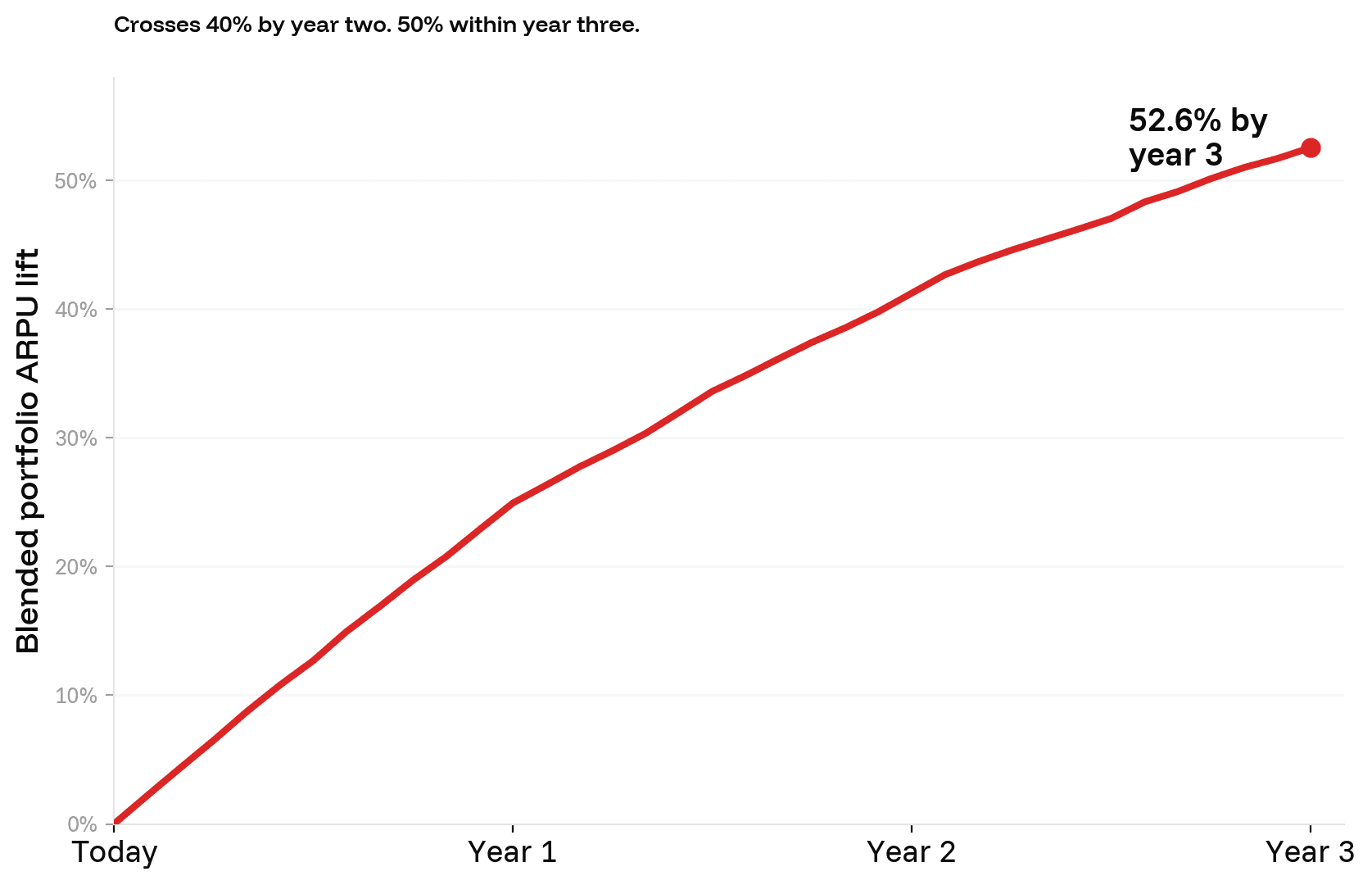
Nobody assumed everyone hits that ceiling on day one. Instead of inventing an adoption curve, the model borrowed Toast's own attach rate, the same one from the S-1, over half of new customers bundling payroll and team management at signup, and ran it against this company's own growth. Assuming the existing back book converts at zero for now, a deliberately conservative floor since nobody publishes that number, the share of the base running payroll lands at 15% in year one, 26% in year two, 33% in year three. Blend that into ARPU across the whole portfolio and the lift builds steadily rather than fast: it crosses 40% by the end of year two, clears 50% within year three, and reaches 52.6% by the three-year mark, the same range the research reported, just spread across multiple years instead of landing on day one, on a timeline backed by real attach and growth numbers rather than a guess.
Every roadmap meeting turns into the same fight: what do we build next.
Picture a Tuesday planning session at a vertical SaaS company, the kind that runs scheduling and day-to-day operations for auto repair shops, restaurants, staffing agencies, or medical practices. Not a real company, just a composite of conversations we've had with a dozen operators in this exact seat. The scenario is made up. The research and the math behind it are not.
Three things are on the table. An AI assistant feature, because every roadmap has one now. A new integration the sales team has been asking for since Q1. And payroll, sitting at the bottom of the list for two quarters because it sounds like someone else's business, not a software company's.
The AI feature gets the excitement. The integration gets the votes, because three deals are stuck on it. Payroll gets a shrug, until someone drops a link in Slack mid-meeting: Tidemark's chapter on embedded payroll, part of the Vertical SaaS Knowledge Project, the closest thing this category has to a shared playbook. Their take is blunt: this is as big a deal for vertical SaaS as embedded payments was, the highest compliment a vertical SaaS investor pays to a product line, and it's enough to buy payroll five more minutes on the agenda.
The piece is full of numbers that aren't guesses. Standard payroll pricing runs $35 to $70 per customer per month plus $6 to $10 per employee, and it can lift a company's overall ARPU by 40 to 50%. Legacy payroll providers Paycom and Paylocity run annual churn of just 7% and 8%, roughly in line with the 8.5% rate at which small businesses close entirely each year, per the Census data cited in the research, which is its way of saying payroll customers basically don't leave once they're in. Toast's own S-1 noted that by the second quarter of 2021, over half of its newly opened restaurant customers bundled payroll and team management the moment they signed on as a Toast customer. And on the economics: a typical embedded partner takes about a third of the revenue, leaving two thirds for the platform selling it, which starts to look generous next to the alternative of building payroll in-house: tax calculations across 6,000-plus taxes, money movement rules that differ across 42 states, and historically a $50 million, three-plus-year project before anyone could process a single paycheck.
A pricing range, a churn benchmark, an attach proof point, a margin structure. All sourced, none invented. The pattern holds whether the customers are auto shops, restaurants, staffing agencies, coffee shops, or the accounting firms that handle books for all of them. Worth running the company's own numbers through that frame.
So that's what happened next. The hypothetical company has 1,000 customers, 10 employees each on average, paying $100 a month flat, the realistic floor for this kind of operations software, not a hopeful low number. Logo churn runs 10% a year. Payroll gets priced at $40 per company plus $10 per employee, landing inside Tidemark's range on the base fee and at the top of it per employee, a deliberate call given how payroll-heavy this customer base runs.
For a customer with 10 employees, that's $140 a month on top of the existing $100. ARPU goes from $100 to $240. That's the ceiling, what one fully-attached customer is worth.
Nobody assumed everyone hits that ceiling on day one. Instead of inventing an adoption curve, the model borrowed Toast's own attach rate, the same one from the S-1, over half of new customers bundling payroll and team management at signup, and ran it against this company's own growth. Assuming the existing back book converts at zero for now, a deliberately conservative floor since nobody publishes that number, the share of the base running payroll lands at 15% in year one, 26% in year two, 33% in year three. Blend that into ARPU across the whole portfolio and the lift builds steadily rather than fast: it crosses 40% by the end of year two, clears 50% within year three, and reaches 52.6% by the three-year mark, the same range the research reported, just spread across multiple years instead of landing on day one, on a timeline backed by real attach and growth numbers rather than a guess.
That's the difference between a model built on a guess and one built on a number Toast already published. It doesn't need to be fast to be convincing.
Lifetime value moved through two separate levers. The extra revenue itself: a customer paying $240 instead of $100 is worth more, full stop. And the churn improvement borrowed straight from the Paycom and Paylocity numbers, 10% down to 7.5%. Three-year customer value went from $3,090 to $4,115, a 1.3x increase, and the bulk of it came from the new revenue line, not from an aggressive story about stickiness nobody had to defend.
Then came the number that actually moves a budget conversation: payback. Assume a blended CAC of $400, swap in the real one. SaaS alone pays back in 5.7 months. SaaS plus payroll pays back in 2.4. Same customer, same CAC, same sales motion, the only thing that changed is what's being sold once they're in the door.
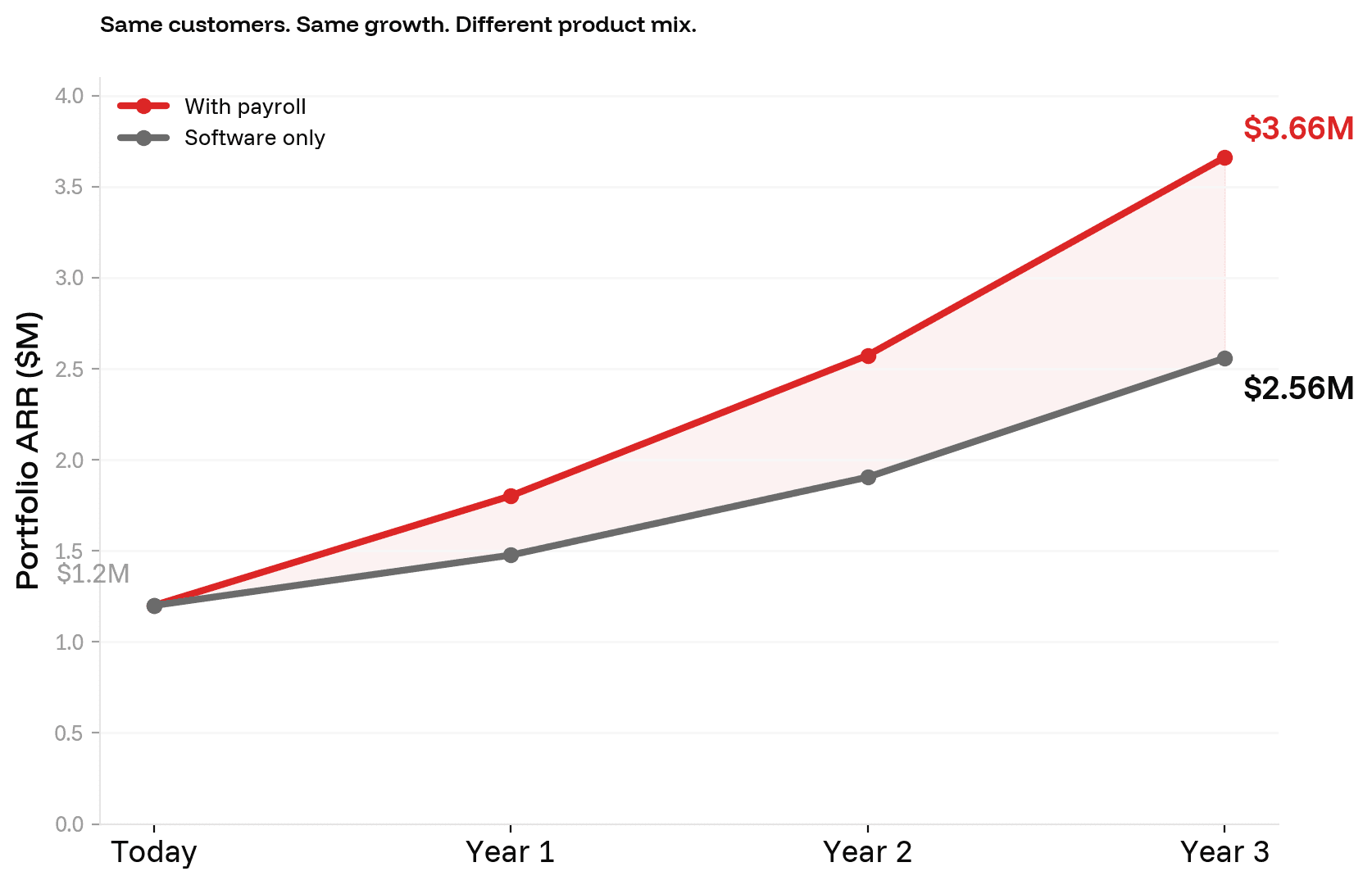
Zoom out to the whole portfolio and it gets harder to argue with. Without payroll, this business grows from $1.2 million to $2.56 million in ARR over three years on logo growth and retention alone. Layer payroll on top of the same customers, no new logos required, and it grows to $3.66 million instead, with annual growth running 50%, then 43%, then 42% versus 23%, 29%, 34% for software alone.
And the line that actually closed the debate: sell payroll into every customer already on the books today, at this pricing, and that's $1.68 million of payroll ARR sitting there unsold. At a 20x revenue multiple, a reasonable range for embedded fintech, that's $33.6 million of enterprise value attached to customers the company already has. Nobody to acquire. Just a product nobody's selling yet.
The AI feature might still ship. The integration probably will too, three stuck deals are a real reason to build something. But payroll moved from "look into eventually" to "next quarter," because it was the only item on the list with a published benchmark and a model behind it instead of a hunch.
The exact numbers will move based on pricing, employees per customer, and churn specific to any given business, which is the whole point of running your own rather than borrowing someone else's.
And on the build-versus-partner question Tidemark raises: that's the category RollFi operates in, infrastructure that lets a platform offer payroll under its own name without taking on the tax filings and compliance work itself, whether that's a tool running auto shops, restaurants, staffing agencies, medical practices, or the accounting firms behind all of them. If you're building vertical SaaS, a B2B neobank, or rolling up accounting firms and want to run this with your actual numbers, we're happy to do it with you.
About Rollfi
Rollfi empowers banks, vertical SaaS platforms, accounting firms, and fintechs to add payroll and benefits to their offerings through white-label solutions and robust APIs. With Rollfi's infrastructure, platforms can unlock new revenue, boost customer retention, and gain valuable payroll data insights. Fast deployment and full regulatory coverage make Rollfi the easiest way to turn your platform into a one-stop shop for essential business services.
Every roadmap meeting turns into the same fight: what do we build next.
Picture a Tuesday planning session at a vertical SaaS company, the kind that runs scheduling and day-to-day operations for auto repair shops, restaurants, staffing agencies, or medical practices. Not a real company, just a composite of conversations we've had with a dozen operators in this exact seat. The scenario is made up. The research and the math behind it are not.
Three things are on the table. An AI assistant feature, because every roadmap has one now. A new integration the sales team has been asking for since Q1. And payroll, sitting at the bottom of the list for two quarters because it sounds like someone else's business, not a software company's.
The AI feature gets the excitement. The integration gets the votes, because three deals are stuck on it. Payroll gets a shrug, until someone drops a link in Slack mid-meeting: Tidemark's chapter on embedded payroll, part of the Vertical SaaS Knowledge Project, the closest thing this category has to a shared playbook. Their take is blunt: this is as big a deal for vertical SaaS as embedded payments was, the highest compliment a vertical SaaS investor pays to a product line, and it's enough to buy payroll five more minutes on the agenda.
The piece is full of numbers that aren't guesses. Standard payroll pricing runs $35 to $70 per customer per month plus $6 to $10 per employee, and it can lift a company's overall ARPU by 40 to 50%. Legacy payroll providers Paycom and Paylocity run annual churn of just 7% and 8%, roughly in line with the 8.5% rate at which small businesses close entirely each year, per the Census data cited in the research, which is its way of saying payroll customers basically don't leave once they're in. Toast's own S-1 noted that by the second quarter of 2021, over half of its newly opened restaurant customers bundled payroll and team management the moment they signed on as a Toast customer. And on the economics: a typical embedded partner takes about a third of the revenue, leaving two thirds for the platform selling it, which starts to look generous next to the alternative of building payroll in-house: tax calculations across 6,000-plus taxes, money movement rules that differ across 42 states, and historically a $50 million, three-plus-year project before anyone could process a single paycheck.
A pricing range, a churn benchmark, an attach proof point, a margin structure. All sourced, none invented. The pattern holds whether the customers are auto shops, restaurants, staffing agencies, coffee shops, or the accounting firms that handle books for all of them. Worth running the company's own numbers through that frame.
So that's what happened next. The hypothetical company has 1,000 customers, 10 employees each on average, paying $100 a month flat, the realistic floor for this kind of operations software, not a hopeful low number. Logo churn runs 10% a year. Payroll gets priced at $40 per company plus $10 per employee, landing inside Tidemark's range on the base fee and at the top of it per employee, a deliberate call given how payroll-heavy this customer base runs.
For a customer with 10 employees, that's $140 a month on top of the existing $100. ARPU goes from $100 to $240. That's the ceiling, what one fully-attached customer is worth.
Nobody assumed everyone hits that ceiling on day one. Instead of inventing an adoption curve, the model borrowed Toast's own attach rate, the same one from the S-1, over half of new customers bundling payroll and team management at signup, and ran it against this company's own growth. Assuming the existing back book converts at zero for now, a deliberately conservative floor since nobody publishes that number, the share of the base running payroll lands at 15% in year one, 26% in year two, 33% in year three. Blend that into ARPU across the whole portfolio and the lift builds steadily rather than fast: it crosses 40% by the end of year two, clears 50% within year three, and reaches 52.6% by the three-year mark, the same range the research reported, just spread across multiple years instead of landing on day one, on a timeline backed by real attach and growth numbers rather than a guess.