
Payroll Is Becoming Invisible...
It's National Payroll Week, and the first thing worth saying is the obvious one: thank you to everyone who does this work.
Payroll is one of the few jobs where doing it perfectly means nobody notices. Get it right and it's invisible. Get it wrong and it's the only thing anyone talks about. The people who run payroll live with that every pay period, absorbing tax changes, jurisdiction rules, and last-minute corrections so everyone else can check their account on Friday and move on.
That's quiet, thankless, hard work, and it deserves the week.
It's also work that has been changing shape for decades. So alongside the thank-you, a look at where payroll has been and where it's going.
How payroll got here
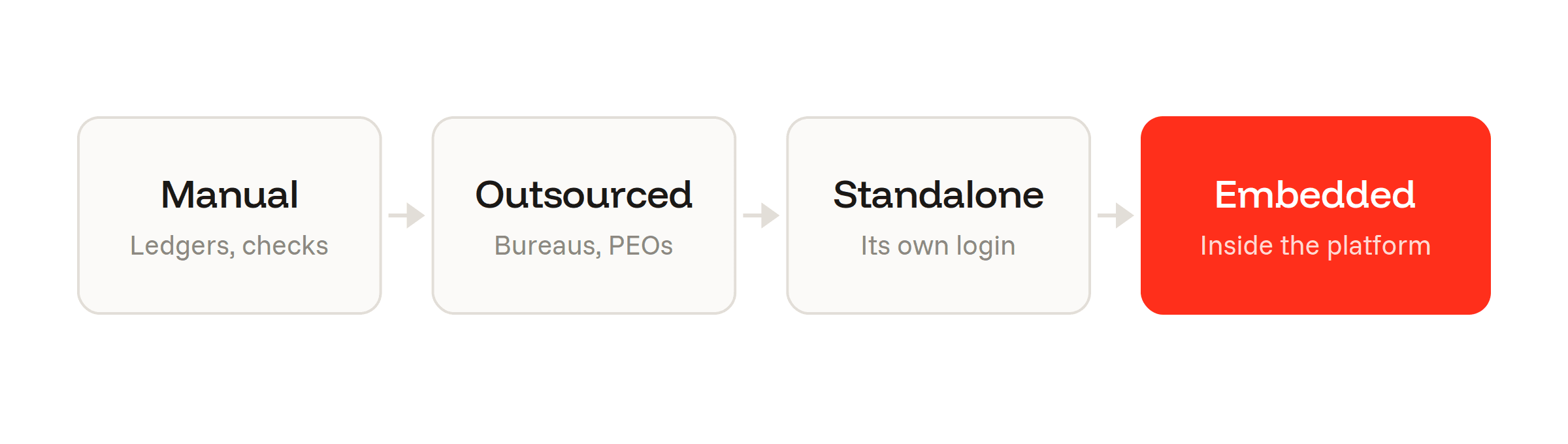
Payroll started as a manual, in-house job. Ledgers, paper checks, someone in the back office doing the math by hand and hoping they didn't transpose a number. It was slow, error-prone, and entirely dependent on one person knowing what they were doing.
Then it got outsourced. Bureaus and PEOs built real businesses on a simple trade: hand us the mess, we'll handle the filings and the checks. Businesses gave up control and visibility in exchange for not having to think about it. For a long time that was a good deal, because the alternative was doing it yourself.
Then it became software. Cloud payroll put the controls back in the business owner's hands. Instead of calling your rep, you logged in, ran payroll yourself, and saw what happened. That was a real leap forward, and it defined the category for over a decade.
Each of those eras solved the problem of the one before it. And each one eventually created its own problem. Manual was too fragile, so we outsourced it. Outsourcing was too opaque, so we built software. And software solved the visibility problem by handing every business owner one more login to manage.
That's the problem we're living in now.
Why embedded payroll is winning
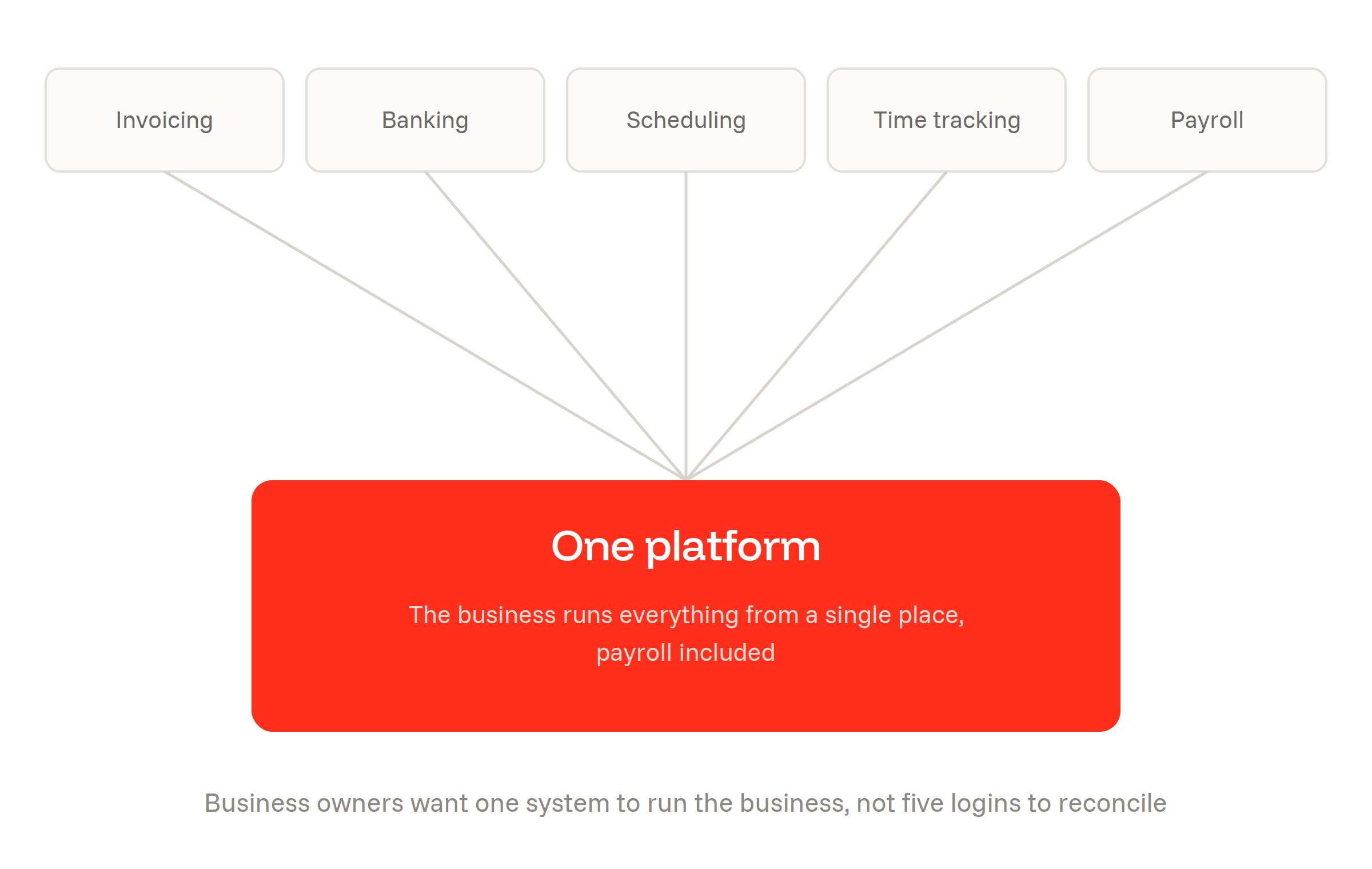
A business owner doesn't wake up wanting a payroll product. They want one place to run their business.
Invoicing, banking, scheduling, time tracking, payroll, all in the same system, without stitching together five different tools and reconciling between them every month. That demand for an integrated way to operate is the actual force behind this shift. Not a strategy deck. Not a category trend. Business owners got tired of being systems integrators for their own company.
Platforms noticed. If a business already lives inside your accounting tool, your vertical SaaS product, or your banking app every day, sending them somewhere else to run payroll is a strange thing to do. So payroll started moving inside the software businesses were already using.
Two things make that shift stick.
The first is that payroll compliance stopped being the hard part. Every serious provider can withhold correctly, file on time, and produce a W-2 in January. That's table stakes, not differentiation. The real competition happens one layer up, in the workflow. How payroll connects to hours a business already tracked. How benefits get bundled in without a separate vendor. How running payroll feels when it's three clicks inside a tool you already had open. Compliance gets you in the room. Workflow keeps a customer from leaving.
The second is that payroll is the system a business owner turns off last before shutting the doors. That makes it one of the stickiest workflows a platform can own. Retention numbers from the big horizontal providers are a floor, not a ceiling. Payroll embedded inside a platform built for a specific industry adds real fit on top of that stickiness, because the platform already understands how that business runs.
Which points at something most platforms still get backwards. Payroll gets treated as a cost center, something to tolerate or bolt on cheaply. It's a revenue line. Platforms that own the payroll relationship add revenue on top of their core product, deepen retention, and get much harder to displace. That's a different conversation than the one happening inside most software and accounting teams, where the instinct is still to cut costs rather than own infrastructure.
Where RollFi fits
We learned this the direct way. RollFi started in 2021 building payroll as a standalone product, and it didn't take long to see that wasn't what the market wanted. Businesses didn't want another login. Platforms didn't want to send their customers somewhere else to run payroll and hope they came back.
So we rebuilt around that. RollFi became embedded payroll infrastructure, built to sit underneath a platform rather than next to it. A modular system with white-label workflows, running on the same APIs we give our partners, with licensed benefits bundled in. We stayed vertical-agnostic on purpose. Most platforms don't need payroll tailored to an industry we haven't proven ourselves in yet. They need infrastructure that works, fast.
In practice, that means going from signed contract to live payroll in under 30 days, across 20-plus platforms today, moving millions of dollars every month. We're also backed by Priority Technology Holdings, a public payments company processing over $150 billion in annual transaction volume. That's a meaningful part of why banks and fintechs put us into production instead of treating embedded payroll as an experiment.
Back to the people who make it work
The work that National Payroll Week celebrates hasn't gotten easier. It's just moved.
More of it now lives inside the software small businesses open every morning, which means the platforms building that software have quietly inherited one of the most consequential jobs in their customers' operations. Getting people paid correctly and on time isn't a feature. It's the thing that makes everything else possible.
To everyone still carrying that weight every pay period: thank you. And to every platform picking up more of it each year: it's worth taking as seriously as they always have.
About Rollfi
Rollfi empowers banks, vertical SaaS platforms, accounting firms, and fintechs to add payroll and benefits to their offerings through white-label solutions and robust APIs. With Rollfi's infrastructure, platforms can unlock new revenue, boost customer retention, and gain valuable payroll data insights. Fast deployment and full regulatory coverage make Rollfi the easiest way to turn your platform into a one-stop shop for essential business services.
It's National Payroll Week, and the first thing worth saying is the obvious one: thank you to everyone who does this work.
Payroll is one of the few jobs where doing it perfectly means nobody notices. Get it right and it's invisible. Get it wrong and it's the only thing anyone talks about. The people who run payroll live with that every pay period, absorbing tax changes, jurisdiction rules, and last-minute corrections so everyone else can check their account on Friday and move on.
That's quiet, thankless, hard work, and it deserves the week.
It's also work that has been changing shape for decades. So alongside the thank-you, a look at where payroll has been and where it's going.
How payroll got here
Payroll started as a manual, in-house job. Ledgers, paper checks, someone in the back office doing the math by hand and hoping they didn't transpose a number. It was slow, error-prone, and entirely dependent on one person knowing what they were doing.
Then it got outsourced. Bureaus and PEOs built real businesses on a simple trade: hand us the mess, we'll handle the filings and the checks. Businesses gave up control and visibility in exchange for not having to think about it. For a long time that was a good deal, because the alternative was doing it yourself.
Then it became software. Cloud payroll put the controls back in the business owner's hands. Instead of calling your rep, you logged in, ran payroll yourself, and saw what happened. That was a real leap forward, and it defined the category for over a decade.
Each of those eras solved the problem of the one before it. And each one eventually created its own problem. Manual was too fragile, so we outsourced it. Outsourcing was too opaque, so we built software. And software solved the visibility problem by handing every business owner one more login to manage.
That's the problem we're living in now.
Why embedded payroll is winning
A business owner doesn't wake up wanting a payroll product. They want one place to run their business.
Invoicing, banking, scheduling, time tracking, payroll, all in the same system, without stitching together five different tools and reconciling between them every month. That demand for an integrated way to operate is the actual force behind this shift. Not a strategy deck. Not a category trend. Business owners got tired of being systems integrators for their own company.
Platforms noticed. If a business already lives inside your accounting tool, your vertical SaaS product, or your banking app every day, sending them somewhere else to run payroll is a strange thing to do. So payroll started moving inside the software businesses were already using.
Two things make that shift stick.
The first is that payroll compliance stopped being the hard part. Every serious provider can withhold correctly, file on time, and produce a W-2 in January. That's table stakes, not differentiation. The real competition happens one layer up, in the workflow. How payroll connects to hours a business already tracked. How benefits get bundled in without a separate vendor. How running payroll feels when it's three clicks inside a tool you already had open. Compliance gets you in the room. Workflow keeps a customer from leaving.
The second is that payroll is the system a business owner turns off last before shutting the doors. That makes it one of the stickiest workflows a platform can own. Retention numbers from the big horizontal providers are a floor, not a ceiling. Payroll embedded inside a platform built for a specific industry adds real fit on top of that stickiness, because the platform already understands how that business runs.
Which points at something most platforms still get backwards. Payroll gets treated as a cost center, something to tolerate or bolt on cheaply. It's a revenue line. Platforms that own the payroll relationship add revenue on top of their core product, deepen retention, and get much harder to displace. That's a different conversation than the one happening inside most software and accounting teams, where the instinct is still to cut costs rather than own infrastructure.
Where RollFi fits
We learned this the direct way. RollFi started in 2021 building payroll as a standalone product, and it didn't take long to see that wasn't what the market wanted. Businesses didn't want another login. Platforms didn't want to send their customers somewhere else to run payroll and hope they came back.
So we rebuilt around that. RollFi became embedded payroll infrastructure, built to sit underneath a platform rather than next to it. A modular system with white-label workflows, running on the same APIs we give our partners, with licensed benefits bundled in. We stayed vertical-agnostic on purpose. Most platforms don't need payroll tailored to an industry we haven't proven ourselves in yet. They need infrastructure that works, fast.
In practice, that means going from signed contract to live payroll in under 30 days, across 20-plus platforms today, moving millions of dollars every month. We're also backed by Priority Technology Holdings, a public payments company processing over $150 billion in annual transaction volume. That's a meaningful part of why banks and fintechs put us into production instead of treating embedded payroll as an experiment.
Back to the people who make it work
The work that National Payroll Week celebrates hasn't gotten easier. It's just moved.
More of it now lives inside the software small businesses open every morning, which means the platforms building that software have quietly inherited one of the most consequential jobs in their customers' operations. Getting people paid correctly and on time isn't a feature. It's the thing that makes everything else possible.
To everyone still carrying that weight every pay period: thank you. And to every platform picking up more of it each year: it's worth taking as seriously as they always have.
About Rollfi
Rollfi empowers banks, vertical SaaS platforms, accounting firms, and fintechs to add payroll and benefits to their offerings through white-label solutions and robust APIs. With Rollfi's infrastructure, platforms can unlock new revenue, boost customer retention, and gain valuable payroll data insights. Fast deployment and full regulatory coverage make Rollfi the easiest way to turn your platform into a one-stop shop for essential business services.
It's National Payroll Week, and the first thing worth saying is the obvious one: thank you to everyone who does this work.
Payroll is one of the few jobs where doing it perfectly means nobody notices. Get it right and it's invisible. Get it wrong and it's the only thing anyone talks about. The people who run payroll live with that every pay period, absorbing tax changes, jurisdiction rules, and last-minute corrections so everyone else can check their account on Friday and move on.
That's quiet, thankless, hard work, and it deserves the week.
It's also work that has been changing shape for decades. So alongside the thank-you, a look at where payroll has been and where it's going.
How payroll got here
Payroll started as a manual, in-house job. Ledgers, paper checks, someone in the back office doing the math by hand and hoping they didn't transpose a number. It was slow, error-prone, and entirely dependent on one person knowing what they were doing.
Then it got outsourced. Bureaus and PEOs built real businesses on a simple trade: hand us the mess, we'll handle the filings and the checks. Businesses gave up control and visibility in exchange for not having to think about it. For a long time that was a good deal, because the alternative was doing it yourself.
Then it became software. Cloud payroll put the controls back in the business owner's hands. Instead of calling your rep, you logged in, ran payroll yourself, and saw what happened. That was a real leap forward, and it defined the category for over a decade.
Each of those eras solved the problem of the one before it. And each one eventually created its own problem. Manual was too fragile, so we outsourced it. Outsourcing was too opaque, so we built software. And software solved the visibility problem by handing every business owner one more login to manage.
That's the problem we're living in now.
Why embedded payroll is winning
A business owner doesn't wake up wanting a payroll product. They want one place to run their business.
Invoicing, banking, scheduling, time tracking, payroll, all in the same system, without stitching together five different tools and reconciling between them every month. That demand for an integrated way to operate is the actual force behind this shift. Not a strategy deck. Not a category trend. Business owners got tired of being systems integrators for their own company.
Platforms noticed. If a business already lives inside your accounting tool, your vertical SaaS product, or your banking app every day, sending them somewhere else to run payroll is a strange thing to do. So payroll started moving inside the software businesses were already using.
Two things make that shift stick.
The first is that payroll compliance stopped being the hard part. Every serious provider can withhold correctly, file on time, and produce a W-2 in January. That's table stakes, not differentiation. The real competition happens one layer up, in the workflow. How payroll connects to hours a business already tracked. How benefits get bundled in without a separate vendor. How running payroll feels when it's three clicks inside a tool you already had open. Compliance gets you in the room. Workflow keeps a customer from leaving.
The second is that payroll is the system a business owner turns off last before shutting the doors. That makes it one of the stickiest workflows a platform can own. Retention numbers from the big horizontal providers are a floor, not a ceiling. Payroll embedded inside a platform built for a specific industry adds real fit on top of that stickiness, because the platform already understands how that business runs.
Which points at something most platforms still get backwards. Payroll gets treated as a cost center, something to tolerate or bolt on cheaply. It's a revenue line. Platforms that own the payroll relationship add revenue on top of their core product, deepen retention, and get much harder to displace. That's a different conversation than the one happening inside most software and accounting teams, where the instinct is still to cut costs rather than own infrastructure.
Where RollFi fits
We learned this the direct way. RollFi started in 2021 building payroll as a standalone product, and it didn't take long to see that wasn't what the market wanted. Businesses didn't want another login. Platforms didn't want to send their customers somewhere else to run payroll and hope they came back.
So we rebuilt around that. RollFi became embedded payroll infrastructure, built to sit underneath a platform rather than next to it. A modular system with white-label workflows, running on the same APIs we give our partners, with licensed benefits bundled in. We stayed vertical-agnostic on purpose. Most platforms don't need payroll tailored to an industry we haven't proven ourselves in yet. They need infrastructure that works, fast.
In practice, that means going from signed contract to live payroll in under 30 days, across 20-plus platforms today, moving millions of dollars every month. We're also backed by Priority Technology Holdings, a public payments company processing over $150 billion in annual transaction volume. That's a meaningful part of why banks and fintechs put us into production instead of treating embedded payroll as an experiment.
Back to the people who make it work
The work that National Payroll Week celebrates hasn't gotten easier. It's just moved.
More of it now lives inside the software small businesses open every morning, which means the platforms building that software have quietly inherited one of the most consequential jobs in their customers' operations. Getting people paid correctly and on time isn't a feature. It's the thing that makes everything else possible.
To everyone still carrying that weight every pay period: thank you. And to every platform picking up more of it each year: it's worth taking as seriously as they always have.
About Rollfi
Rollfi empowers banks, vertical SaaS platforms, accounting firms, and fintechs to add payroll and benefits to their offerings through white-label solutions and robust APIs. With Rollfi's infrastructure, platforms can unlock new revenue, boost customer retention, and gain valuable payroll data insights. Fast deployment and full regulatory coverage make Rollfi the easiest way to turn your platform into a one-stop shop for essential business services.